
Waqf in India: Rights, Resistance & Reform
CSAS is proud to have organized the Waqf in India: Rights, Resistance and Reform Conference, hosted by the American Islamic College (Chicago) and Aliah University (Kolkata) , examining one of the most consequential legal and political issues facing Muslim communities in India today.
Waqf , the Islamic institution of charitable endowment , has shaped Muslim civic, educational, and religious life in South Asia for centuries. The recent Waqf Amendment Act, 2025 has brought this institution to the center of national debate, raising critical questions about minority rights, constitutional safeguards, and the future of Muslim public institutions in India.
Organizing this conference reflects CSAS's commitment to advancing rigorous scholarship on South Asian Muslim communities and amplifying urgent civic conversations within the diaspora and beyond.
Visit Conference Website ↗Conference Details
Venue
Roosevelt University – Schaumburg Campus (Oct 19) & Online via Google Meet (Oct 21)
Dates
October 19 & 21, 2025
Hosted by
American Islamic College & Aliah University
Organized by
Center on South Asian Studies
Publication
Manchester Journal of Transnational Islamic Law & Practice (Scopus Q2)
Talks from the Conference
Watch selected talks from the Waqf in India Conference, featuring leading legal scholars and advocates examining the Waqf Amendment Act and its implications.
 Talk
Talk
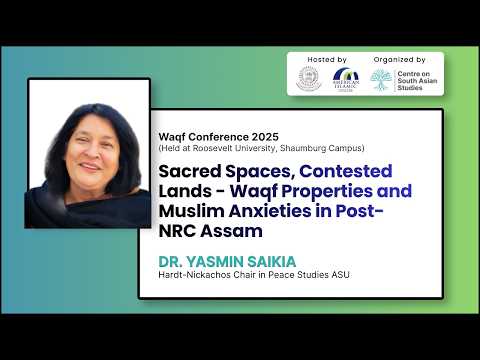
Sacred Spaces, Contested Lands
Dr. Yasmin Saikia (Arizona State University) on Waqf properties and Muslim anxieties in post-NRC Assam.
Watch on YouTube ↗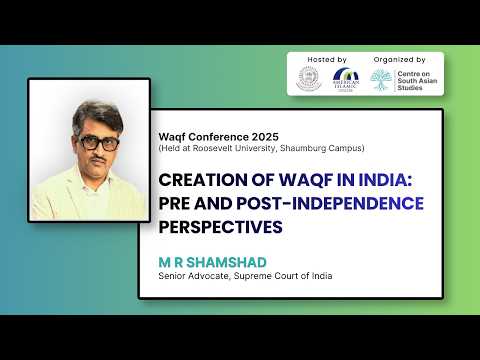 Keynote
Creation of Waqf in India
M R Shamshad, Senior Advocate, Supreme Court of India, on pre- and post-independence perspectives.
Watch on YouTube ↗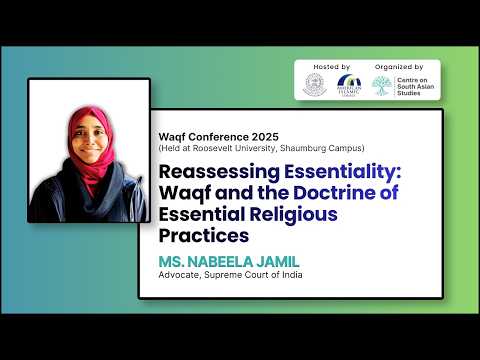 Talk
Talk
Reassessing Essentiality
Ms. Nabeela Jamil, Advocate, Supreme Court of India, on Waqf and the doctrine of Essential Religious Practices.
Watch on YouTube ↗Four Themed Sessions
The conference brings together legal scholars, historians, policy experts, and community advocates across four sessions that collectively examine the Waqf Amendment Act through legal, constitutional, judicial, and policy lenses.
Law & the Politics of Muslim Identity
Examining how legal language and public debate frame Muslim identity in contemporary India, and how waqf ties to broader institutional challenges facing Muslim civic life.
Constitutional Safeguards & Waqf Governance
Exploring the constitutional protections available to Muslim endowments and the tension between state regulation and religious autonomy under Indian law.
Waqf Amendment Act & the Indian Judiciary
Analyzing how judicial decisions have shaped waqf governance and what role the courts will play in reviewing the constitutionality of the 2025 Amendment.
Reconceptualising Waqf through Policy
Imagining pathways for reform — how can waqf institutions be reconceptualized to serve communities effectively while preserving their religious and charitable character?
A Critical Moment for Muslim Institutions in India
Waqf endowments — mosques, schools, hospitals, graveyards, and community properties — have sustained Muslim civic life in South Asia for over a thousand years. The Waqf Amendment Act, 2025 fundamentally alters how these endowments are governed, raising profound questions about minority rights, secularism, and constitutional principles.
"The conference explores the socio-legal implications of the Waqf Amendment Act, 2025, its constitutional challenges, and the political mobilization around Muslim identity, minority rights, and religious autonomy."
At a time when South Asian Muslim communities face mounting pressures on their institutions, this conference provides a calm, rigorous, and evidence-based space for legal scholars, historians, and community leaders to think carefully about what is at stake — and what paths forward might look like.
Our Shared Commitment
In organizing the Waqf Conference, CSAS focused on three core commitments.
Civic & Legal Scholarship
Supporting rigorous academic inquiry into the legal rights, constitutional protections, and institutional challenges facing South Asian Muslim communities.
Preserving Muslim Institutions
Advocating for the protection and proper governance of waqf endowments as pillars of Muslim civic, educational, and religious life across South Asia.
Diaspora Engagement
Connecting the South Asian diaspora in the United States with the critical debates shaping the future of Muslim communities in India and the subcontinent.
Conference Papers to Be Published
Full papers from the conference will be included in a Special Issue of the Manchester Journal of Transnational Islamic Law and Practice (MJTILP) — a Scopus Q2-indexed journal — in June 2026.